Titre
Horta
Auteur
BORSI, FRANCO (1925) / PORTOGHESI, PAOLO (1931)
Langue
Français
Éditeur
J.-M. Collet, Braine-l'Alleud. 1996. Nouvelle édition. Relié. Hardbound. Illustrée.
Prix
€ 345,00
Détails
Text in French. Mint condition! New.
Plus d'informations
BORSI, FRANCO (1925) / PORTOGHESI, PAOLO (1931)
Horta
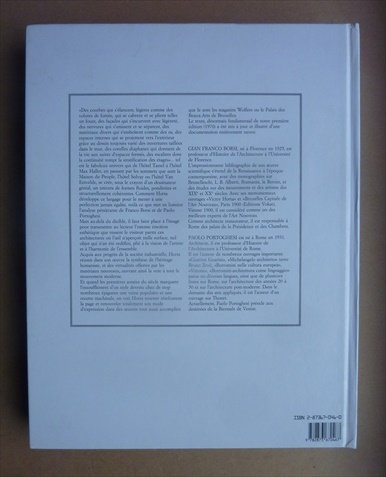
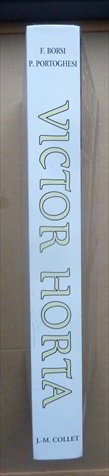
J.-M. Collet, Braine-l'Alleud. 1996. Nouvelle édition. Relié. Hardbound. Illustrée. 411 pages. 25¼ x 32¼ x 4 cm. 2745 gr. ISBN-10 2-87367-046-0. ISBN-13 978-2-87367-046-7. Traduit de l'italien par Jean-Marie van der Meerschen. Préface de Jean Delhaye. Jaquette de couverture: Hôtel van Eetvelde. Vitrail du lanterneau éclairant le hall octogonal. Frontispiece Hôtel Tassel. Détail de la rampe en ferforgée de la volée d'escalier conduisant au grand bureau du premiere étage. Illustration profonde en couleurs et en n/b. Notes, chronologie, orientation bibliographique, index.
A pioneer of art nouveau, Belgian architect Victor Horta (1861-1947) developed a theory of forms in the hope of influencing human behavior by inducing harmony and comfort. A cobbler's son, he built houses for the bourgeoisie and, according to the authors, provocatively evoked the world of labor and industrial production. Although we tend to think of art nouveau as an exotic hothouse flower, Borsi ( Vienna 1900 ) and Italian architect Portoghesi ( Postmodern ) argue that many of Horta's designs have a consciously political meaning, for example, the Maison du Peuple, a communal complex in Brussels, symbolizes an alliance between a workers' movement and reforming industrialists. Featuring hundreds of color and black-and-white photographs and drawings, as well as detailed essays, this beautiful album investigates Horta's musical motifs, gothic and symbolist influences, and his golden decade prior to WW I, after which he dropped out of the modernist movement and reverted to an eclectic classicism.
This lavishly illustrated work highlights the brilliant career of Belgian architect Horta, originator of the Art Nouveau Movement. Among the buildings showcasing his innovative exterior and interior designs are the Hallet, Tassel, and Van Eetvelde houses, L'Innovation department store, museums, hospitals, and his ultimate triumph, the Maison du Peuple (Worker's Union Hall), all of which were a marriage of ideological and political factors. The chapters intertwine an informative text with floor plans, scale drawings, and exquisite illustrations of Horta's signature features, including the whiplash, the curve as optical correction, asymmetry, multiple axes, osmotic surfaces, whirling arrangement of space, and transparency. A chronology includes the current status of Horta's buildings. This notable volume is the first translated into English on the life of Horta. Recommended for libraries emphasizing architecture and the decorative arts. - Stephen Allan Patrick, East Tennessee State Univ. Lib., Johnson City
Text in French. Mint condition! New.
BOOKNUMBER: 919
Horta
J.-M. Collet, Braine-l'Alleud. 1996. Nouvelle édition. Relié. Hardbound. Illustrée. 411 pages. 25¼ x 32¼ x 4 cm. 2745 gr. ISBN-10 2-87367-046-0. ISBN-13 978-2-87367-046-7. Traduit de l'italien par Jean-Marie van der Meerschen. Préface de Jean Delhaye. Jaquette de couverture: Hôtel van Eetvelde. Vitrail du lanterneau éclairant le hall octogonal. Frontispiece Hôtel Tassel. Détail de la rampe en ferforgée de la volée d'escalier conduisant au grand bureau du premiere étage. Illustration profonde en couleurs et en n/b. Notes, chronologie, orientation bibliographique, index.
A pioneer of art nouveau, Belgian architect Victor Horta (1861-1947) developed a theory of forms in the hope of influencing human behavior by inducing harmony and comfort. A cobbler's son, he built houses for the bourgeoisie and, according to the authors, provocatively evoked the world of labor and industrial production. Although we tend to think of art nouveau as an exotic hothouse flower, Borsi ( Vienna 1900 ) and Italian architect Portoghesi ( Postmodern ) argue that many of Horta's designs have a consciously political meaning, for example, the Maison du Peuple, a communal complex in Brussels, symbolizes an alliance between a workers' movement and reforming industrialists. Featuring hundreds of color and black-and-white photographs and drawings, as well as detailed essays, this beautiful album investigates Horta's musical motifs, gothic and symbolist influences, and his golden decade prior to WW I, after which he dropped out of the modernist movement and reverted to an eclectic classicism.
This lavishly illustrated work highlights the brilliant career of Belgian architect Horta, originator of the Art Nouveau Movement. Among the buildings showcasing his innovative exterior and interior designs are the Hallet, Tassel, and Van Eetvelde houses, L'Innovation department store, museums, hospitals, and his ultimate triumph, the Maison du Peuple (Worker's Union Hall), all of which were a marriage of ideological and political factors. The chapters intertwine an informative text with floor plans, scale drawings, and exquisite illustrations of Horta's signature features, including the whiplash, the curve as optical correction, asymmetry, multiple axes, osmotic surfaces, whirling arrangement of space, and transparency. A chronology includes the current status of Horta's buildings. This notable volume is the first translated into English on the life of Horta. Recommended for libraries emphasizing architecture and the decorative arts. - Stephen Allan Patrick, East Tennessee State Univ. Lib., Johnson City
Text in French. Mint condition! New.
BOOKNUMBER: 919
Images


Willy Demacker Books
Amsterdam 
Let op: uit ervaring blijkt dat ons antwoord via Boekwinkeltjes in uw Spam-box terecht kan komen. Lijkt het erop dat u geen antwoord krijgt? Kijk daar dan even !!! Het overgrote deel van onze boeken staat (nog) niet online.
Mail (willydemacker@gmail.com) of bel/app (0633 700 886) wanneer u een titel zoekt.
Niet geschoten is altijd mis.
- Tous les livres sont en état complet et normal, sauf indication contraire. De petites imperfections comme une page collée ou un nom sur la feuille ne sont pas toujours mentionnés
- Vous gérez directement cette commande avec Willy Demacker Books
- Après votre commande vous et Willy Demacker Books recevrez une confirmation par e-mail. Dans l'e-mail que vous pouvez trouver, vous pouvez trouver le nom et l'adresse de Willy Demacker Books
- L'acheteur paie les frais de livraison, sauf accord contraire
- Willy Demacker Books peut demander un prépaiement
- Boekwinkeltjes.nl essaie de rapprocher les acheteurs et les vendeurs. Boekwinkeltjes.nl n'est jamais impliqué dans un accord entre l'acheteur et le vendeur. Si vous avez un différend avec un ou plusieurs utilisateurs, vous devez le réparer vous-même. Vous indemnisez Boekwinkeltjes.nl de toute réclamation.